
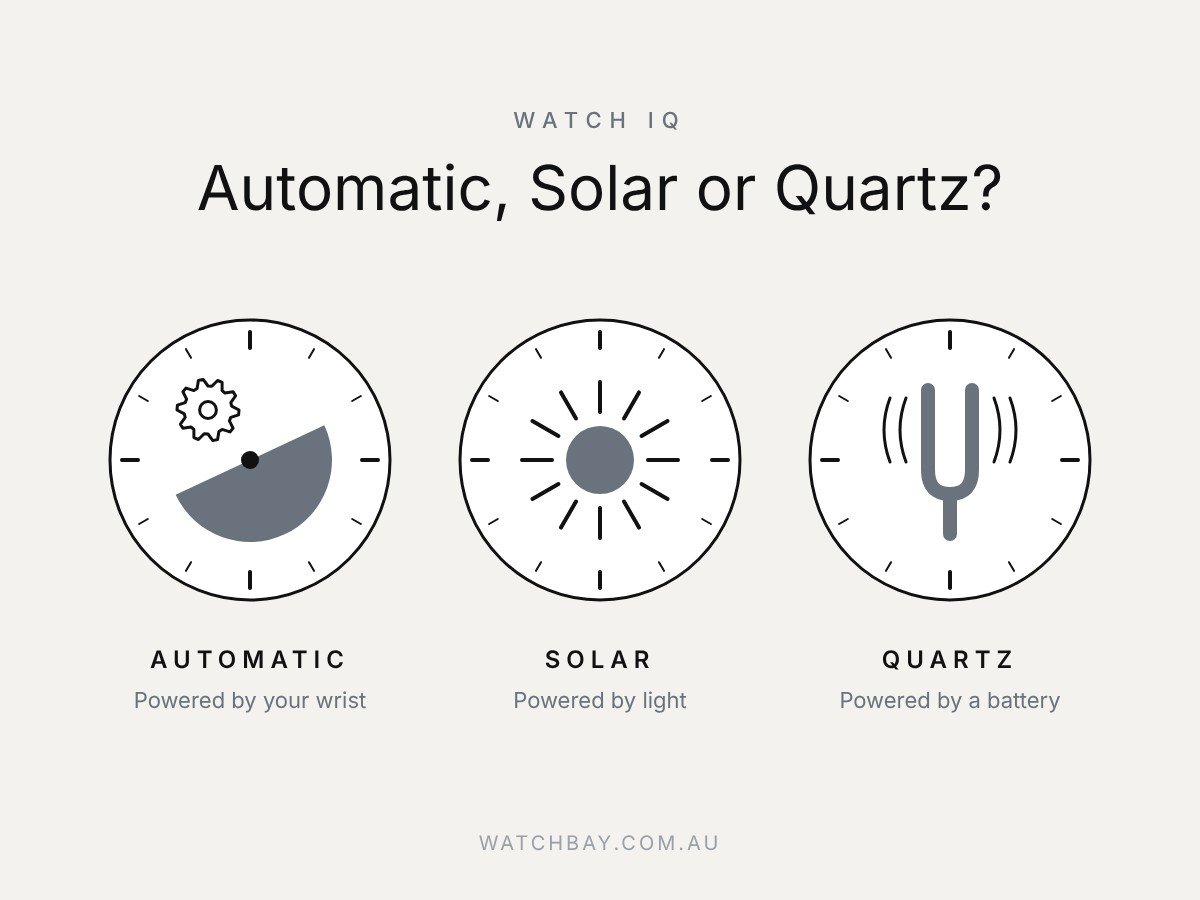
Every watch needs a way to keep time and a source of power to keep it running. That combination is called the movement, and it shapes almost everything about how a watch feels to own: how accurate it is, how often it needs attention and even how the seconds hand moves across the dial.
Most watches you will come across use one of three movement types: quartz, solar or automatic. None of them is simply better than the others. Each suits a different kind of owner, and knowing how they work makes choosing a lot easier.
Quartz: accurate, simple and low maintenance
A quartz watch runs on a small battery. The battery sends a current through a tiny piece of quartz crystal, which vibrates at a very precise frequency, usually 32,768 times per second. A circuit counts those vibrations and drives a small motor that moves the hands once every second.
Because the crystal is so stable, quartz is very accurate. A typical quartz watch keeps time to within around 15 to 20 seconds a month, which is far tighter than most mechanical watches. It is also light, thin and tough, with very few moving parts to wear out.
- Strengths: excellent accuracy, low cost of ownership, keeps running when it sits in a drawer.
- Trade-offs: the battery needs replacing every few years, and the one-tick-per-second movement of the seconds hand feels less traditional to some people.
Solar: quartz without the battery changes
A solar watch is a quartz watch with a different power source. Instead of a disposable battery, it has a solar cell, usually hidden beneath a semi-transparent dial, that turns light into electricity and stores it in a rechargeable cell. Natural daylight charges it fastest, but ordinary indoor light also helps.
You get the same quartz accuracy, but without regular battery changes. Once fully charged, many solar watches will run for several months in complete darkness, and some models run much longer in a power saving mode. Many also warn you when the charge is low, often by making the seconds hand move in jumps.
- Strengths: quartz accuracy, very little upkeep, no routine battery replacements.
- Trade-offs: it needs regular exposure to light, so a watch stored in a dark drawer for months can run flat. The rechargeable cell can also wear out eventually, although it typically lasts many years.
Automatic: mechanical craft powered by your wrist
An automatic watch is fully mechanical. There is no battery and no circuit. Power is stored in a coiled spring called the mainspring. Inside the case, a weighted rotor spins as you move your arm and winds that spring. The energy is then released in small, controlled steps through a set of gears and a balance wheel that swings back and forth several times every second.
This is what gives an automatic its smooth, sweeping seconds hand, and it is why many people find them more engaging to wear. You can often watch the movement working through a display caseback.
Accuracy is measured in seconds per day rather than per month. Depending on the calibre, an automatic might gain or lose a few seconds a day or a little more, and that is normal. Fully wound, most automatics run for somewhere between about 40 and 80 hours off the wrist. Many can also be wound by hand with the crown, which is useful if the watch has stopped.
- Strengths: no battery, traditional craftsmanship, a sweeping seconds hand and a long working life with proper care.
- Trade-offs: less accurate than quartz, stops if left unworn for a couple of days, and benefits from a professional service every several years.
Quartz vs solar vs automatic at a glance
| Quartz | Solar | Automatic | |
|---|---|---|---|
| How it is powered | Battery | Light, stored in a rechargeable cell | Wrist movement winds a mainspring |
| Typical accuracy | Within about 15 to 20 seconds a month | Within about 15 to 20 seconds a month | Several seconds a day, more or less depending on the calibre |
| Seconds hand | Ticks once per second | Ticks once per second | Smooth, sweeping motion |
| Running without wear | Until the battery runs out, often 2 to 5 years | Several months on a full charge, longer on some models | Roughly 40 to 80 hours |
| Main upkeep | Battery changes | Regular light; occasional rechargeable cell replacement after many years | A full service every several years |
| Best for | Grab and go reliability | Low upkeep with no battery changes | People who enjoy mechanical craft |
Which movement suits you?
A few honest questions will usually point you in the right direction:
- Do you want to put it on and forget about it? Quartz or solar. Solar is the better choice if you would rather never think about batteries and the watch will see daylight regularly.
- Will the watch sit unworn for long periods? Quartz handles this best. A solar watch needs light to stay charged, and an automatic will stop within a few days.
- Do you enjoy how things work? An automatic offers something the others cannot: a small mechanical engine that runs on your own movement.
- Is precision your priority? Quartz and solar will comfortably outperform most automatics day to day.
- Will you rotate between several watches? Quartz and solar are easy to pick up and wear. Automatics are easy too, but you will often need to reset the time and give them a few turns of the crown.
Looking after each type
- Quartz: have the battery changed promptly when it runs down, ideally by someone who can check the seals, since an old battery can leak.
- Solar: store it where it can get some light, such as a windowsill out of direct heat, rather than in a closed drawer.
- Automatic: wear it regularly or use a watch winder, keep it away from strong magnets, and plan for a service every several years to keep it running well.
The bottom line
Quartz gives you accuracy and simplicity, solar adds freedom from battery changes, and automatic brings the character of a mechanical watch. The right movement is the one that fits the way you actually wear a watch.
You can browse our automatic watches, quartz watches and solar watches to compare options. If you are unsure which suits you, email contact@watchbay.com.au and we will give you a straight answer.